Original Article: Dynamic ultrasound scattering analysis of highly concentrated bimodal silica suspensions
A novel “dynamic ultrasonic scattering (DSS) method” enabling the analysis of highly concentrated, bimodal silica particle suspensions has been developed.
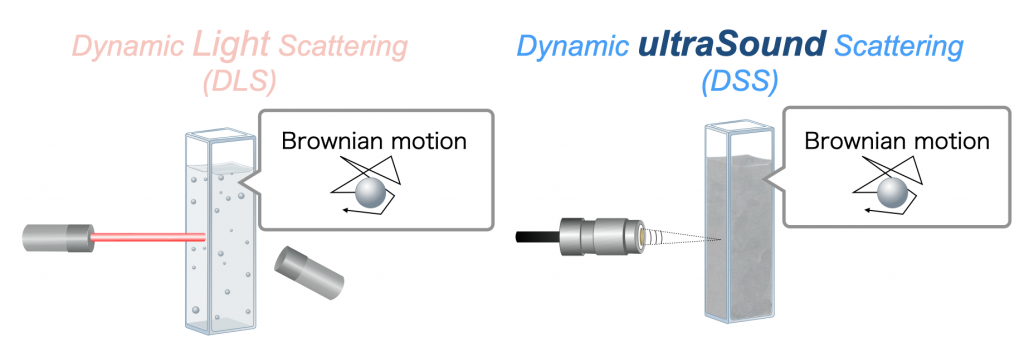
In our laboratory, we have succeeded—for the first time—in tracking the “motion of nanoparticles” in “real time” using “ultrasound.” Since we use ultrasound rather than visible light to observe nanoparticles that are invisible to our eyes, the state of the suspension can be determined even if it is “opaque.” Dynamic light scattering (DLS) is a well-known method for determining the size distribution of particles “in liquid state” without drying the sample, as is necessary with electron microscopy, even when the particles are far smaller than the wavelength of light (as small as about 1 nm). The DSS method is the ultrasonic version of this technique and represents an innovative technology in the industrial field, which is now beginning to be adopted by companies (Fig. 1).
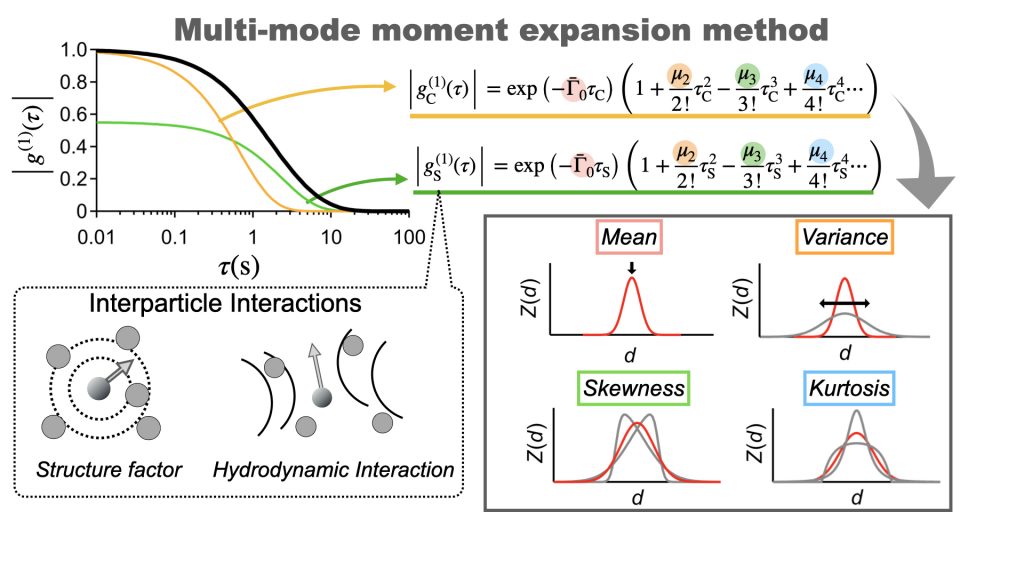
Next, when particle concentrations are extremely high, a major challenge arises not only in determining whether “the beam can pass through the sample” but also in “interpreting the obtained signal.” We have developed a method that simultaneously determines the particle size distribution while incorporating particle interactions (Structure Factor, Hydrodynamic Function), and have already published a multi-mode moment expansion method that can be applied even to polydisperse systems where particle sizes are not uniform (Fig. 2). Note that this method should also be applicable to DLS.
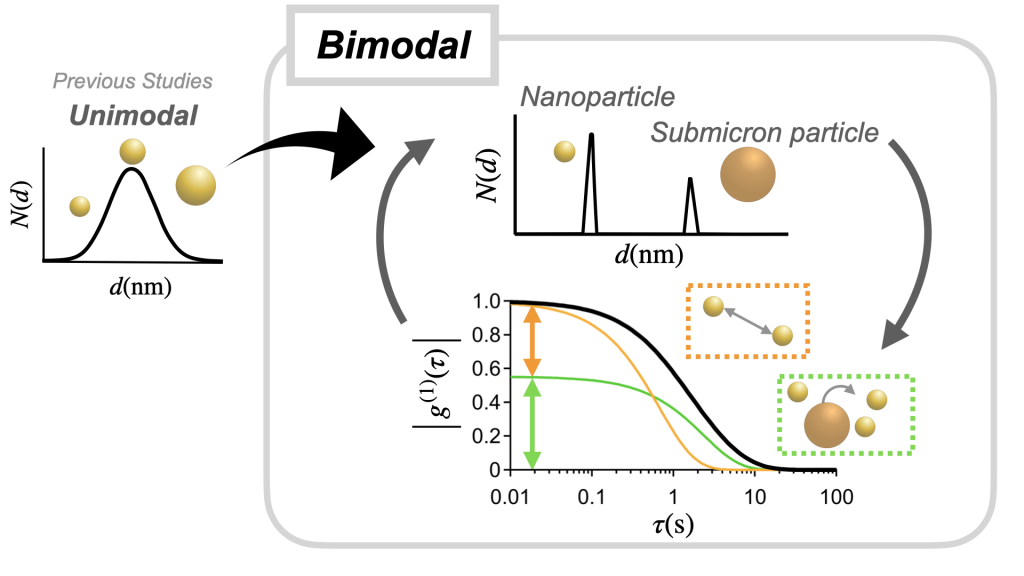
However, our previous paper was limited to cases where the particle size distribution had a single peak. Although polydispersity (the non-uniformity of particle sizes) was taken into account, modeling cases with significantly different particle sizes—such as bimodal distributions where the size difference is very pronounced, for example, between nanoparticles and submicron particles—remained a major challenge (Fig. 3). This presents a frustrating dilemma: when setting the model parameters—specifically, the “ratio” between the dynamics information derived from “interactions” and the individual particle information derived from the “particle size distribution”—we must first “know” the particle size distribution. Unfortunately, the particle size distribution required for the analysis is precisely the “unknown parameter” we are trying to determine.
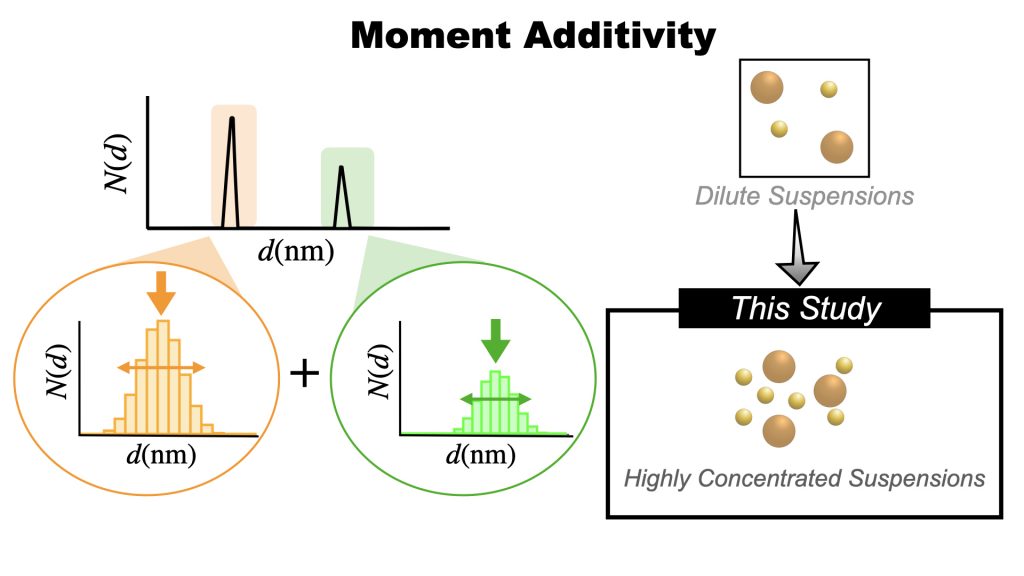
In this study, we proposed a new algorithm called the “moment additive method” and presented a method for calculating bimodal particle size distributions without introducing any additional unknown parameters (Fig. 4). Although bimodal samples have been tested in previous DLS and DSS studies, these were limited to low concentrations. What is fundamentally different this time is that we no longer “need to dilute the sample.” Since we have found a method to simultaneously solve for bimodal interactions and polydispersity at very high concentrations, this new technique allows anyone to perform particle size analysis without dilution. Please refer to the paper for details.