

Original article: Ultrasonic Viscoelastic Analysis of Sorbitol Droplets
A paper on viscoelastic analysis of microparticles focusing on resonance phenomena between ultrasound and microparticles, submitted to the Japanese Journal of Applied Physics (IOPscience) on December 27, 2025, has been accepted for publication.
When testing the hardness of materials, various methods exist—tensile testing for fibers, bending tests for films, and so on (Figure 1). But how can we determine the hardness of tiny, tiny “particles” invisible to the naked eye, especially when they remain suspended in a liquid?
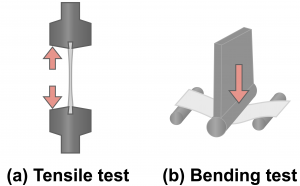
Fig. 1 Schematic of a typical tensile test and bending test.
This research paper presents a non-destructive method for evaluating the viscoelastic properties of microparticles using ultrasonic analysis. As a research group specializing in ultrasonic scattering, we have previously developed methods to precisely evaluate particle “size” and “elastic modulus” using mathematical and physical models (by solving inverse matrices). However, applying this technique required knowledge of particle elasticity, density, and the wave physics governing the conversion of compressional ultrasonic waves into shear waves upon entering solid particles. Most critically, the analysis demanded numerous parameters, including density, intrinsic absorption, viscosity, and thermal properties. The so-called ECAH model (by Epstein, Carhart, Allegra, and Hawley) is a representative model for ultrasonic scattering by spherical particles.
This research proposes a method to evaluate the viscoelasticity of microparticles very simply, without requiring knowledge of such rigorous ultrasonic scattering theory. When ultrasonic waves of an appropriate frequency for the particle size are irradiated, a strong resonance signal, schematically shown in Figure 2, is observed. Therefore, it has become possible to evaluate the particle’s elastic modulus G‘ and viscous loss G” using only the peak frequency (fmax) at which this signal is observed and the peak width (PW) at that frequency. This resonance scattering between the microparticles and the ultrasonic waves utilizes the phenomenon where surface waves propagating around the particle surface interact constructively.
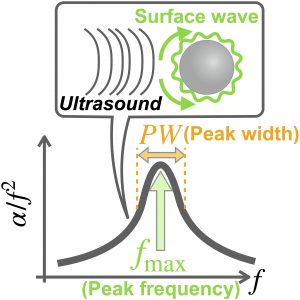
Fig. 2 Schematic diagram of the frequency peak in the ultrasonic attenuation spectrum and the surface wave traveling around the particle.
To clearly observe this phenomenon, we have also carefully designed our samples. The sorbitol shown in Figure 3 is a six-carbon sugar alcohol widely used as a sweetener and moisturizer. An aqueous solution containing a small amount of sorbitol is like water. However, as the concentration increases, it becomes extremely viscous. In this state, it exhibits the viscosity of a liquid but also displays the elasticity of a solid. Further increasing the concentration transforms it into a fairly hard elastic solid. In other words, by evaporating water from a sorbitol aqueous solution, one should be able to uniformly observe a series of drying stages: from a “low-viscosity” dilute solution, through a “high-viscosity” viscoelastic liquid, to a “solid” elastic body. In this study, we further emulsified this sorbitol aqueous solution as “water droplets” in oil. Specifically, we achieved the analysis of viscosity and elasticity at the level of a single water droplet within a water-in-oil (W/O) emulsion.
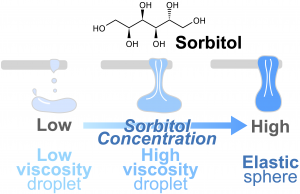
Fig.3 Schematic of sorbitol droplets becoming elastic spherical particles via low-viscosity and high-viscosity droplets
In our previous research, we presented a method for converting the peak frequency appearing in the frequency spectrum of the ultrasonic attenuation coefficient into the surface wave sound velocity or shear velocity. This enables the quantitative determination of the shear elastic modulus. In that study, particles were treated as perfectly elastic bodies, and viscous loss components were neglected. However, materials like rubber or viscous liquid at room temperature exhibit significant viscous losses in addition to elasticity. This behavior broadens the aforementioned attenuation coefficient spectrum, enabling the identification of viscous losses. While employing rigorous ultrasonic scattering theory is valid, our approach now allows for the “simple and straightforward” evaluation of both elasticity and viscosity “within the particle.”