

Original Article: Dynamics of highly concentrated and polydisperse silica particles
A paper describing the analysis of a “highly concentrated” and “polydisperse” silica particle suspension using a novel technique called nano-Dynamic Sound Scattering (nano-DSS) has been published.
Highly concentrated microparticle suspensions are known to be quite turbid, making analysis using optical methods such as light scattering extremely difficult (Figure 1). We have developed a unique technology utilizing ultrasound and have previously reported on the potential of the DSS method for nanoparticles and submicron particles. For the background on the subject, please refer to our previous article. While we have previously studied highly concentrated, polydisperse silica particle suspensions, a recent study revealed that the “surface charge” of silica particles can have a curious effect on particle behavior (the effect persists even at concentrations where it should normally disappear). This study describes the dynamics (particle diffusion) of “polydisperse” silica particle suspensions at an “ultra-high concentration”, observable only via DSS.
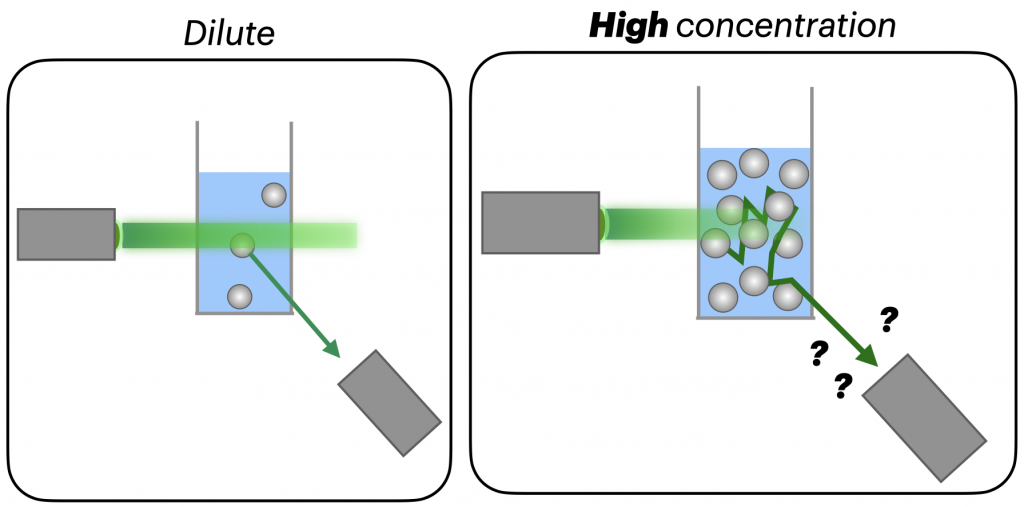
FIG. 1 Schematic of light scattering experiments of a particle suspension with low (left) and high (right) concentrations. At low concentrations, light transmits sufficiently, allowing accurate analysis of each particle’s information. However, at high concentrations, multiple scattering often makes it difficult to properly evaluate particle size.
Ultrasound can easily transmit through high-concentration silica particle suspensions exceeding 40 wt% to examine particle motion. However, this research does not merely “measure” particles using the transmitted beam. For highly concentrated particle suspensions, interactions are extremely complex, making it inappropriate to directly apply analytical methods developed for dilute systems. First, when there is a particle size distribution, a regression parameter analysis of the size distribution is performed, considering factors that characterize it: the average particle size (mean), the width of the distribution (variance), the asymmetry of the distribution (skewness), and the shape of the distribution tails (kurtosis) as shown in Figure 2.
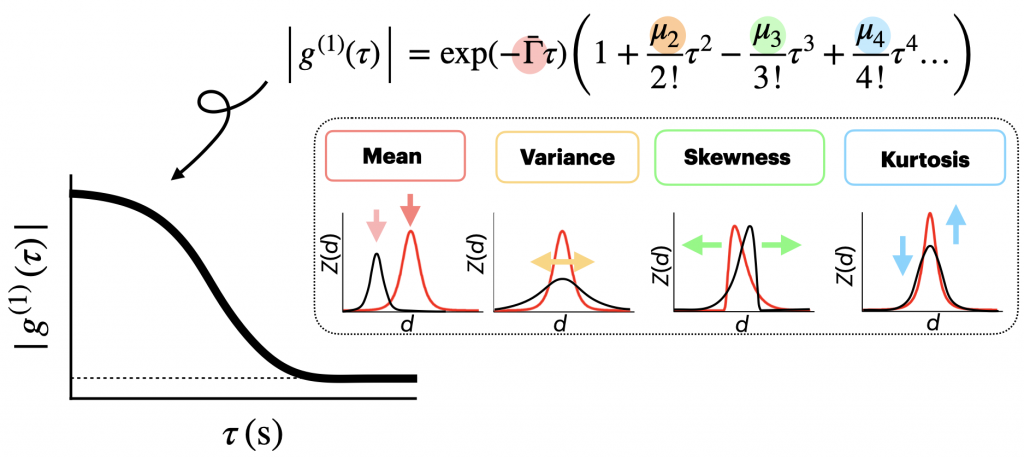
FIG. 2 Using a method called moment expansion, a highly concentrated microparticle suspension is analyzed by incorporating information about the particle size distribution.
Here, interparticle interactions vary depending on each particle’s size. Furthermore, the relative contributions to the interaction depend on the wavelength used for exploration, as seen from both macroscopic (cooperative mode) and microscopic (self-mode) perspectives (Figure 3).
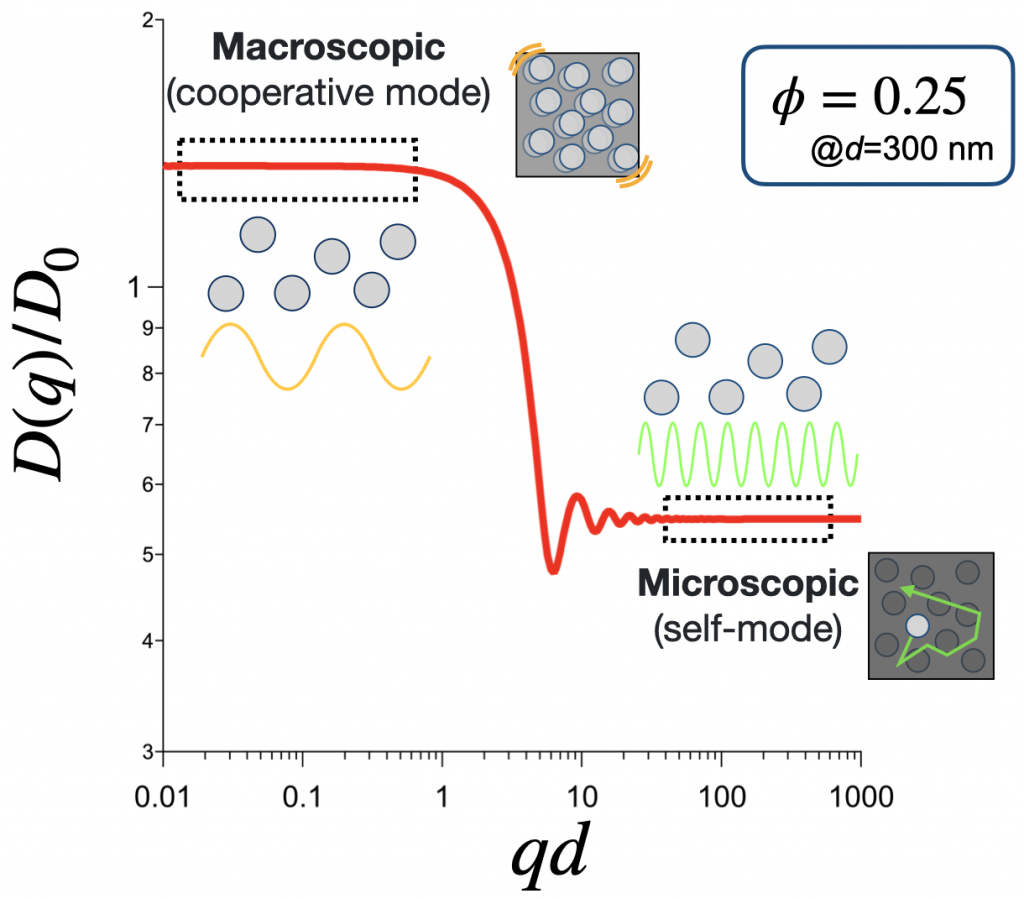
FIG. 3. A small qd at the horizontal axis corresponds to a macroscopic field, while a large qd corresponds to a microscopic field where q is the magnitude of scattering vector and d is the nominal diameter. At large scales, many particles are observed moving cooperatively. At microscopic scales, individual particles can be identified, revealing the motion of the individual particles themselves. At intermediate wavelengths, the system exists in an interplay between these two states, making analysis extremely difficult. The DSS method always enables measurements under conditions of small qd, allowing interactions to be simplified for analysis.
The silica particles used in this study had a number-average diameter of 61 nm and a relatively high polydispersity of 26% (Figure 4).
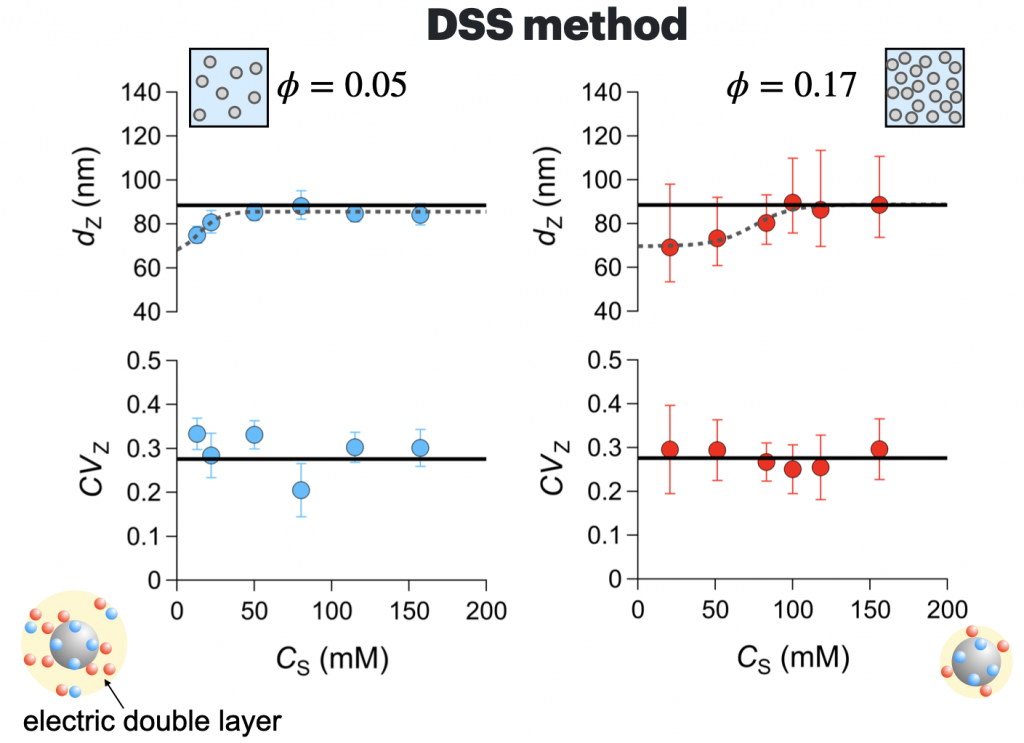
FIG. 4 Result of average particle size (dz) and polydispersity (CVz) analysis obtained by DSS. While accurate measurements are possible at low concentrations with a moderate amount of salt (50 mM) added, it was found that salt concentrations as high as 100 mM are required when particle concentrations are high. This phenomenon does not occur with monodisperse particles.
Although the original solution contained an appropriate amount of salt to screen off the effects of excess surface charge, we found that electrostatic interactions still significantly influenced the behavior of these polydisperse particles. This paper demonstrates that highly concentrated, polydisperse particle size distributions can be evaluated under conditions with appropriate salt concentrations. We also investigated the utility of the recently introduced 3D-modulated cross-correlation dynamic light scattering (3D-mod-DLS) method, which can be applied under high-concentration conditions (Figure 5).
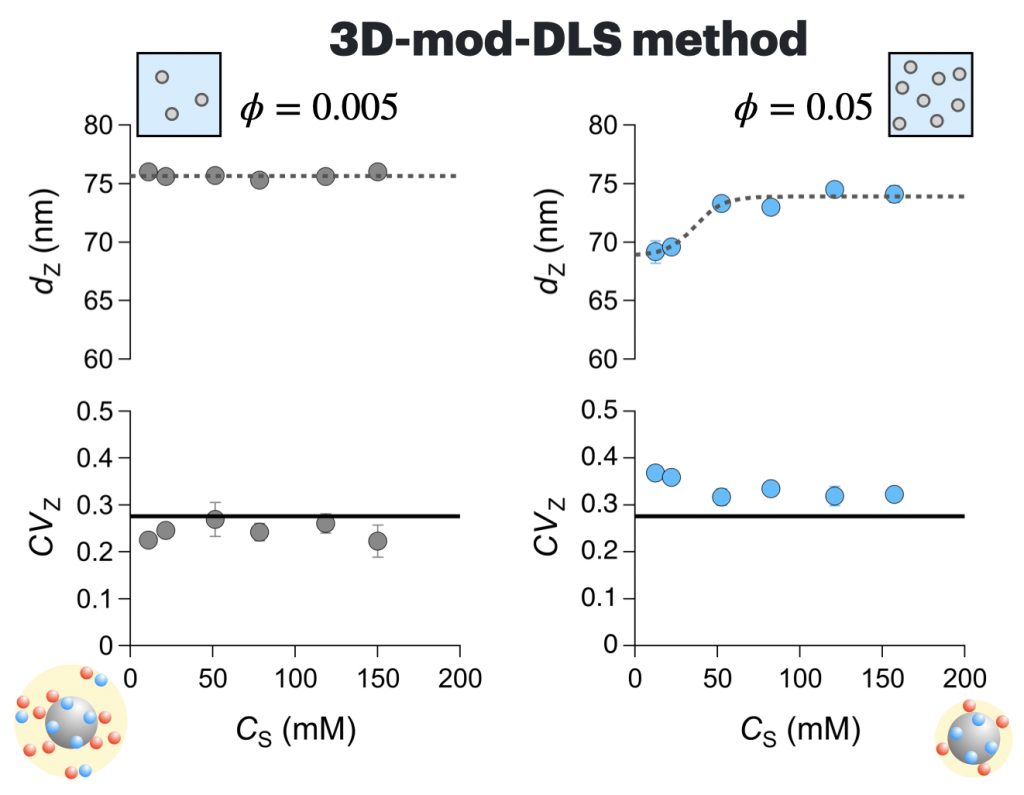
FIG. 5 Results of average particle size (dz) and polydispersity (CVz) analysis obtained by 3D-mod-DLS. At ultra-low concentrations, accurate measurements are achieved with a small amount (10 mM) of salt added. However, when particle concentration reaches approximately 5 vol%, electrostatic interactions persist up to a salt concentration of about 50 mM, similar to DSS results. While DLS tends to slightly underestimate particle size, the values are relatively close and correctly capture the trend. DSS and TEM results agreed.
While not as suitable for extremely high concentrations as DSS, 3D-mod-DLS can be used up to a certain concentration level and yielded results consistent with those obtained by DSS. Although light scattering has a wavelength of several hundred nm, which introduces wavelength-dependent interactions at high concentrations, it generally provides comparable results. This paper confirms the potential of our DSS method for highly concentrated, polydisperse particle suspensions.